№ 02The Faculty
Margaret Holroyd.
Non-Executive Director, Holroyd Cleaver Group; three FTSE 250 boards.
On governance, theatre, and the difference between them.
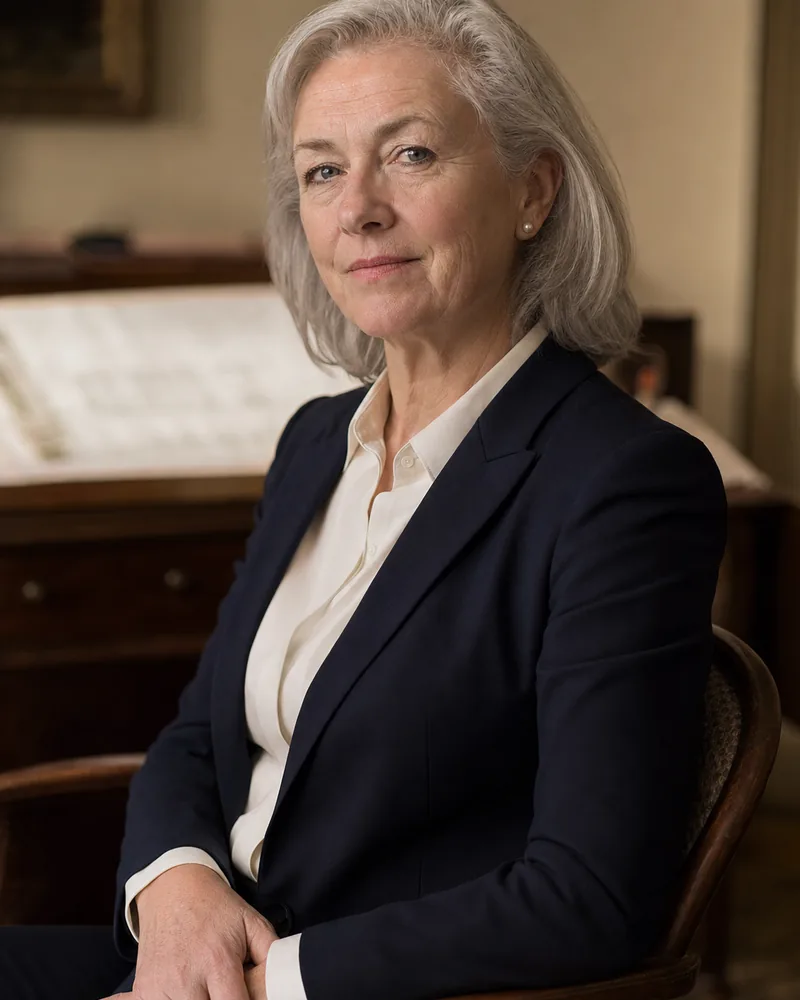
A board paper that takes twenty minutes to read tells you what the executive does not yet want to say.
The work
Margaret holds three non-executive directorships across FTSE 250 boards in engineering, infrastructure, and one regulated utility she declines to name in print. She chairs the audit committee on two of them and sits on the remuneration committee on the third. She writes a private circulation note four times a year on board practice; the list is short and the renewal rate is high. She takes one new chairing assignment a year and turns down the rest. She has never used the word stakeholder in a board paper she has written herself.
Background
She trained as a chartered engineer and came up through manufacturing in the West Midlands during the years that the British manufacturing base was supposed to be terminal. It was not terminal. Margaret spent eighteen years inside a mid-cap engineering business that exported to seven countries and lost money twice in that period. She knows the inside of a foundry, a costed bill of materials, and a properly bored shareholder letter, in roughly that order.
She became chair of Holroyd Cleaver Group in 2008, six months before the credit crisis. She stayed for eleven years. The group did not raise emergency capital, did not breach a covenant, and did not lose any of its three operating site leaderships in that decade. She would tell you, plainly, that this is the kind of period in which a chair is mostly trying not to break what is already working.
Signature contribution
Margaret is known for the difference between governance and theatre, and she has made a public point of that difference for a long time. Theatre, in her usage, is everything a board does because it looks like the right thing to do: a long strategy day, a deck of forty slides, a vote on a resolution that was already agreed by phone the previous Sunday. Governance is the harder thing: reading the second memo, the one that explains why the first memo was wrong, and asking the executive to redraft.
Her quarterly note has been circulating in private since 2014. The list is not advertised. It runs to about three hundred chairs and senior NEDs. The format is unvarying: one observation, two pages, no slides, no references, signed Margaret. She has been wrong in print four times that she will admit to. The subsequent issue in each case said so.
In practice
Ask Margaret how she runs an audit committee and she will describe a particular pause. After the auditor has presented and the executive has commented, she leaves a beat of about four seconds before she speaks. The pause is deliberate. Most people in the room will rush to fill it; she lets one of them. What they say in those four seconds is normally the question the meeting actually needs to answer. She learnt the pause from a chair she sat under in the early nineties whose name she will not give in print.
Governance is reading the second memo. Theatre is admiring the first one.
Outside the work
She lives in the Welsh Marches in a small house with a large garden in which she grows roses badly. She reads more biography than is healthy, mostly nineteenth-century, mostly women, and re-reads Hilary Mantel in long winters. She drives a fifteen-year-old estate car and intends to drive it for another ten.
The chair’s job, on the worst day of the year, is to be the one person in the room who is not allowed to look surprised.