№ 04The Faculty
Eleanor Vaisey.
Former Director General, Treasury and Cabinet Office.
On the long work of strategy in institutions that change slowly.
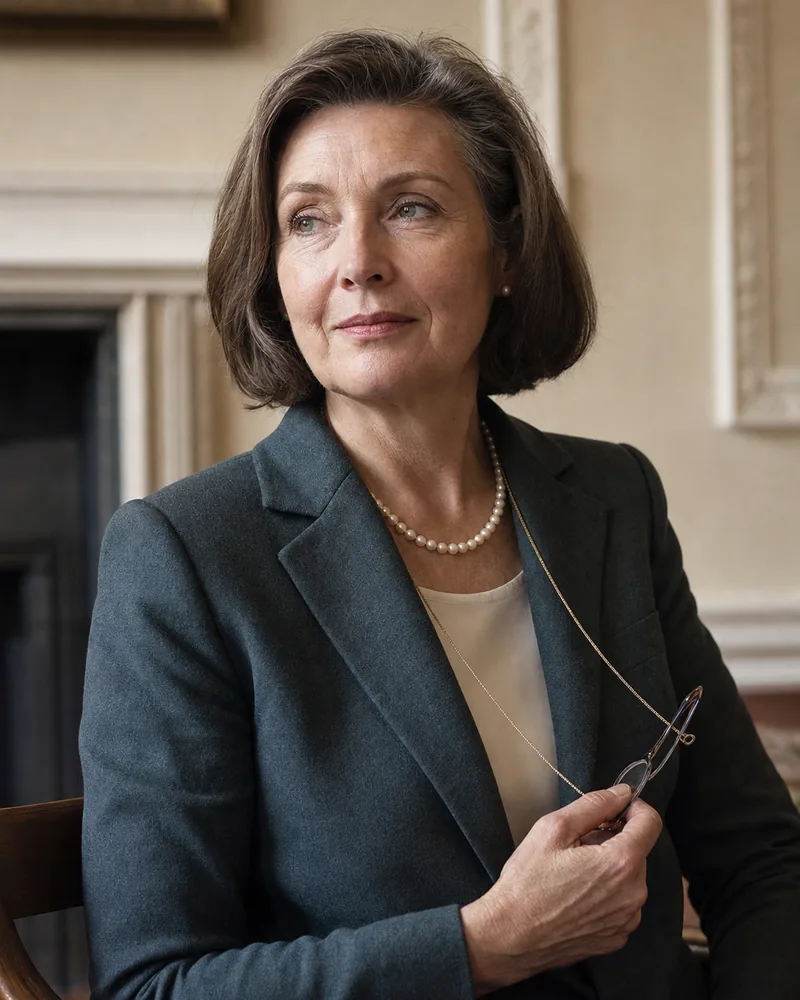
Strategy in a public institution is the patient refusal to confuse a restructuring with a decision.
The work
Eleanor sits on four boards in the broadly public-interest space: a post-graduate research institution, a national-scale charity, a regulator subsidiary, and a strategy advisory body she founded with two colleagues two years ago. She chairs none of them, by choice. She writes one long essay a year on policy strategy for a small academic journal and gives one keynote a year, normally outside the United Kingdom. The rest of her week is divided between reading, slow correspondence, and the eight or nine private conversations a month she has with senior officials who would like a second view.
Background
She read classics at Oxford in the early eighties and joined the Treasury on the fast stream the autumn after. She spent twenty-three years in the Treasury and four in the Cabinet Office across two administrations and three prime ministers. Her last formal role was Director General for strategy and public service reform, a brief which she would describe, with some humour, as the brief in which a fast stream is told to fix the things the slow stream knew were broken in 1978.
She left the civil service in 2019. She did not write a memoir. The book she is currently working on is on the policy uses of the long meeting, and is expected, eventually.
Signature contribution
Eleanor is known inside government for a particular kind of patience. She is the official who, in a room full of younger people convinced that the problem requires a new structure, will ask whether the old structure has been given the resources it was promised in 2003. The question is irritating because it is always relevant. Her former colleagues call it the Vaisey question.
Outside government she is known for the founding of a small strategy advisory body that takes paid work only from publicly accountable organisations: national charities, regulators, university trusts, the occasional foundation. She turns down corporate work. The body has four senior fellows and a research associate. It writes one report a year. The reports are published in full and the methodology is in the appendix; the appendix is read more than the report.
In practice
Ask Eleanor how she advises a senior official and she will say she does very little advising. She asks the official to tell her, in their own words, what they think the question actually is. She then asks them to write that down. Most of the official’s hour is spent writing. Eleanor reads it back. When she leaves she does not give them a paper. She gives them, sometimes, two or three sentences of revision to what they have written. The work is the writing.
The senior question is not what to do. It is what to stop doing, in writing, to the colleagues who will inherit the consequences.
Outside the work
She lives in a small terraced house in north Oxford that she has owned since 1989 and where her now-adult sons reliably forget the alarm code. She walks five miles most days, in any weather, and reads novels in three languages, two of which she will admit to in public. She has never knowingly been on television.
A long meeting is not a failure of brevity. It is, sometimes, the only venue in which a slow thought can survive.